Successful Dental Treatment
Getting the Best Possible Results

Dentistry can do amazing things to change the way you look, feel and function. We as healthcare professionals want not only to treat you, but also to educate you about the “why” behind our recommendations. With more information, you are better equipped to make confident decisions about your health and treatment options. In addition, you are more likely to be successful in keeping your teeth vibrant and healthy.
We as dental professionals have learned, through science, research and technology, that when patients are looking to improve their health and appearance, it's essential for them to know what led to the current conditions in their mouths as those factors can have a significant impact on the success of their treatment. In order to create a foundation for future health as well as a beautiful new smile, your susceptibility to dental problems must be identified and managed as a team effort.
It is important for you and your dentist to have realistic expectations about what dentistry can and can't do. Successful results ultimately depend upon an analysis of all the factors that have made you “you,” dentally speaking. This includes your experience of tooth decay, gum disease, and bite or chewing problems. This type of analysis creates a basis for predicting successful treatment, both with and without dental care. Based on your unique diagnosis, a plan of action can be developed to correct or at least manage those factors that can interfere with the success of your treatment.
A plan for positive change should lay out what you can expect, detail how risk factors have contributed to your current condition, suggest changes that would benefit you going forward, and help determine how you will look and function after treatment.
Predictable success really is the name of the game. When your dentist considers your individual risk factors for disease, he or she is better able to advise you about dental treatment and safeguard your health. Hopefully, this understanding will allow you to change or modify behaviours so that your dental treatment will be more successful and you will achieve lasting health.
 |
| The cycle of dental care includes the identification, assessment and treatment of the causes of a patient's disease as well as future monitoring and maintenance of health. |
Creating A Favourable Future
During your evaluation and treatment planning phases it is crucial to weigh factors that can increase or decrease elements of risk and affect prognosis (outcomes) in order to judge the chances of failure or success of particular treatments — before we undertake them. More simply stated, treatment decisions are favourable when risk for disease is lowered and compromised if risk cannot be controlled. You can think of it in the same way you would approach a home renovation. If you do a survey analysis of your house and find it has a weak foundation, risk for future problems goes up. You can improve success if you shore up the foundation first. And what if you are renovating a house on a fault line? Well, that is important to know beforehand as well. Sometimes we have to make decisions about how best to proceed, knowing that we cannot completely eliminate risks for future problems. Let's take a closer look at how all this relates to your dental health and aesthetic goals.
Identifying Risks To Successful Dental Treatment
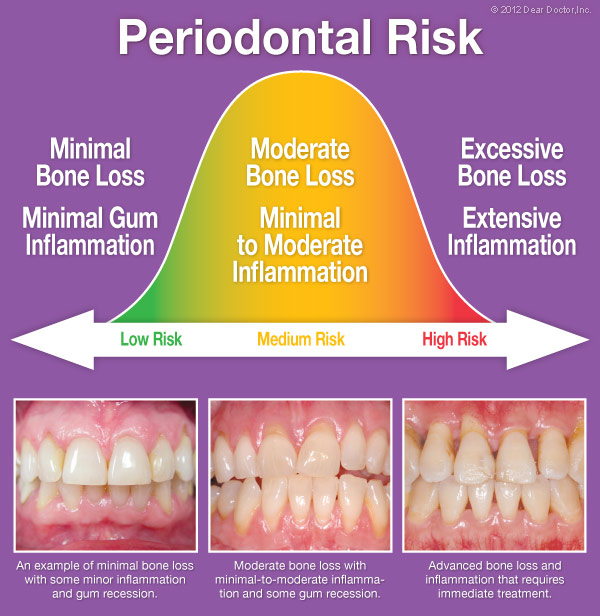
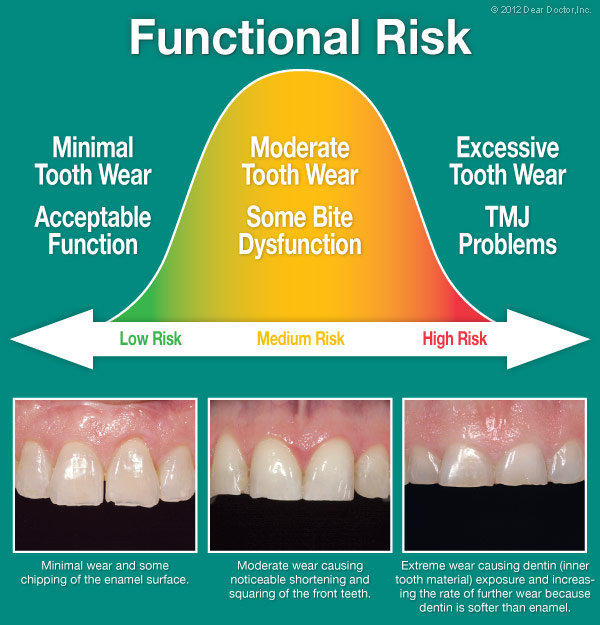
In planning your dental treatment, risk level is determined from an assessment within four fundamental categories: Periodontal Risk, Biomechanical Risk, Functional Risk and Aesthetic Risk.
Periodontal Risk
This comprises threats to structures that support your teeth, particularly bone. If bone is being or has been lost, you are at greater risk for tooth loss from periodontal (gum) disease. This risk may be influenced by systemic (general) health conditions such as diabetes and habits such as smoking. Risk can be managed by changing personal behaviours and ensuring optimal oral hygiene. Periodontal risk (“peri” – around; “odont” – tooth) can also be affected by inflammatory conditions such as cardiovascular (“cardio” – heart; “vascular” – blood vessel) disease, and vice versa. These health conditions should be controlled with the help of your physician. For those who are highly susceptible to periodontal disease, the risk cannot always be completely eliminated; treatment decisions must take this into consideration.
Biomechanical Risk
This involves the structural integrity of the teeth — past tooth structure loss due to decay (cavities), acid erosion, and fracture, as well as susceptibility to decay. Certainly the higher your decay activity or rate, the higher the risk of structural (tooth) compromise. Addressing bacterial, dietary, salivary (dry mouth) and other known risk factors can help minimize the risk for future decay. If teeth are severely compromised by tooth decay, their removal and replacement with dental implants may be recommended to lower biomechanical risk.
Functional Risk
This relates to how teeth, muscles and jaw joints are functioning and wearing. This assessment involves categorizing your bite — the way the teeth fit together and how you chew. It involves assessing muscle forces generated during biting, which can affect the way the teeth wear, cause tooth looseness by affecting their attachment to the bone, and/or affect the temporomandibular (jaw) joint (TMJ). For example, if you have worn your teeth excessively it is important to figure out why your teeth have worn and look the way they do. If the problem is not addressed, the same wear patterns can result in breakage of the teeth and damage to tooth restorations (crowns or veneers, for example). Moving, reshaping, or restoring the teeth might accomplish this but the important part is to establish and address functional risk before proceeding with any treatment. For a small percentage of people functional risk cannot be eliminated, in which case an oral appliance such as an occlusal (bite) guard should be used to protect teeth during stressful periods and/or when sleeping.
Aesthetic Risk
This is really about how your teeth look and thus the risk tends to be more subjective. It is based on an assessment of “tooth display” and (ideal) tooth position in relation to your face. Aesthetic risk is higher in those who display more of their teeth and gum tissue when smiling. In these cases, any aesthetic issues affecting teeth and gums — gum recession, for example — are that much more visible and influential to your smile. Because aesthetic value is subjective, your personal opinion will be a large consideration.
Understanding Treatment as it Relates to Your Risk Assessment
Today, we have the blessings of modern technology and data analysis of your clinical situation to assess your needs and formulate a treatment plan with realistic goals in mind. Using a risk-based assessment system helps ensure an accurate diagnosis and a treatment plan with reasonable and achievable goals. We need to place emphasis on the need to prevent oral health problems from progressing so you can receive the best and longest-lasting care possible at the lowest financial, as well as psychological and emotional, cost.
 We came across this interesting diagram today that we would like to share with you regarding tooth loss. The statistics are based on scenarios in the UK but here in Canada, hygiene practices are very similar and scenarios are quite comparable. This diagram points out that the problems of tooth loss are not inevitable if you replace the lost tooth with an implant.